
Choosing between WordPress vs Shopify is one of the most important platform decisions founders make in 2026 if you want to start an online business. This choice affects not only how your website looks, but also how much control you have, how much you pay over time, and how easily your business can grow.
Both platforms are popular and powerful. However, they are built with very different philosophies. One focuses on ownership and flexibility, while the other focuses on simplicity and speed.
In this guide, I will break down WordPress vs Shopify in simple terms, so you can choose the platform that actually fits your business goals instead of following trends or marketing hype.
Many founders avoid costly mistakes when this decision is made early during proper WordPress website development and eCommerce planning.
What is WordPress?
WordPress is an open source website platform used by businesses of all sizes around the world. It powers blogs, company websites, portfolios, and large eCommerce stores.
With WordPress, you have full control over your website, hosting, content, and data. You decide how your website is built, optimized, and scaled over time. You can learn more about the platform on the official WordPress website at https://wordpress.org.
WordPress is flexible by design, which makes it suitable for long term business growth.
What is Shopify?
Shopify is a hosted eCommerce platform designed specifically for selling products online.
It takes care of hosting, updates, security, and basic performance optimizations. Shopify is often chosen by founders who want to launch an online store quickly with minimal technical involvement.
However, this convenience comes with platform limitations, recurring fees, and less control over how your store works internally.
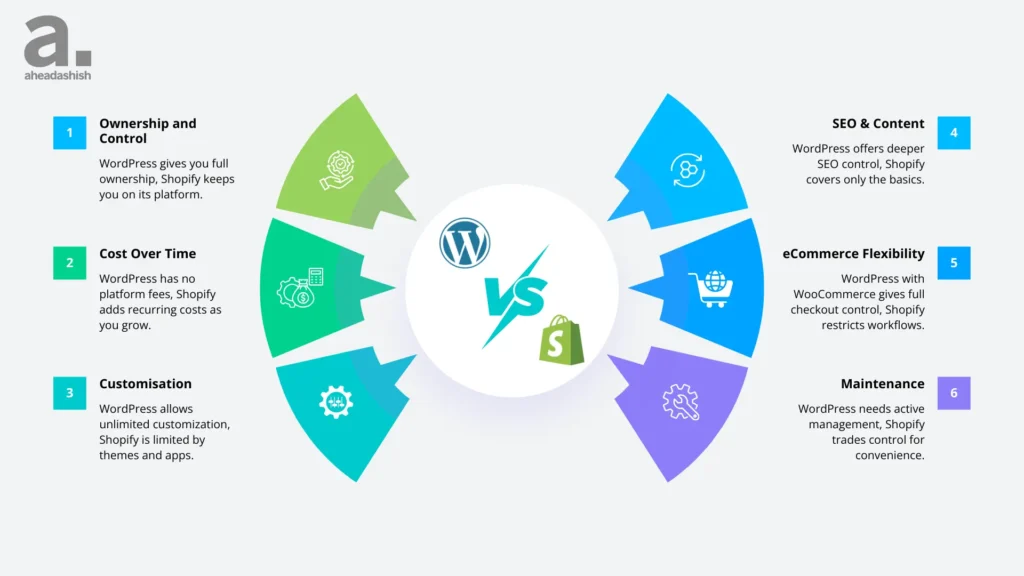
WordPress vs Shopify: Ownership and Control
Ownership is one of the biggest differences when comparing WordPress vs Shopify.
With WordPress, you fully own your website, your data, and your content. You can move hosting providers, change infrastructure, or redesign your site without platform restrictions. This level of control becomes especially important when your site is built with long term WordPress development in mind.
With Shopify, your store runs entirely on Shopify’s system. You cannot move the platform itself, and you must follow Shopify’s policies, pricing changes, and feature limitations.
For founders who value independence and long term control, WordPress usually feels more comfortable.
WordPress vs Shopify: Cost Comparison
Cost is another major factor in the WordPress vs Shopify decision.
Shopify charges a monthly subscription, transaction fees, and additional costs for apps and advanced features. As your store grows, these recurring costs often increase.
WordPress does not charge a platform fee. Costs usually include hosting, themes, plugins, and initial development. While setup may require more planning, long term costs are often lower and more predictable.
For bootstrapped founders, this difference can significantly impact profitability.
WordPress vs Shopify: Design and Customization
WordPress offers deep customization options. You can design your website exactly how you want and change things later without being locked into a specific system.
Shopify provides good quality themes, but customization beyond those themes often requires paid apps or development within Shopify’s constraints.
If branding, flexibility, and future changes matter to you, WordPress offers more creative freedom.
WordPress vs Shopify for SEO
SEO plays a critical role in long term traffic growth.
WordPress gives you full control over URLs, content structure, internal linking, schema, and performance optimization. This makes WordPress a strong choice for content driven businesses.
Shopify handles basic SEO well, but deeper control is limited. Blog and content SEO often feels restrictive compared to WordPress.
If organic traffic and content marketing are part of your strategy, WordPress usually performs better over time.
WordPress vs Shopify for eCommerce
Shopify is designed specifically for eCommerce and works well for quick store launches.
WordPress with WooCommerce offers more flexibility but requires proper configuration. You control checkout flow, product data, payment gateways, and integrations without platform restrictions.
For Indian businesses, WordPress works very well with gateways like Razorpay, PhonePe, and Stripe, especially when transaction fees and customization matter.
WordPress vs Shopify: Scalability and Growth
Both platforms can scale, but in different ways.
Shopify handles traffic scaling automatically, but costs increase as sales, apps, and features grow.
WordPress scales through better hosting, caching, and infrastructure planning. This requires more involvement but gives you control over performance and cost optimization.
Founders planning long term growth often prefer scalable WordPress setups built with the right foundation.
WordPress vs Shopify: Maintenance and Responsibility
Shopify handles most technical maintenance automatically, which reduces responsibility but also limits control.
With WordPress, updates, backups, and security need attention. However, when WordPress website development is done correctly, maintenance becomes simple and predictable. When done correctly, professional WordPress website development makes updates, backups, and security predictable and easy to manage.
Many founders move to WordPress once they realize maintenance does not need to be complex or stressful.
Which Platform Should You Choose?
Choose WordPress if you want full ownership, strong SEO control, flexibility, and long term cost efficiency.
Choose Shopify if you want to launch quickly, avoid technical involvement, and are comfortable with monthly fees and platform limitations.
There is no universally better option. The right platform depends on your business model, growth plans, and priorities.
A Smarter Way to Decide Between WordPress and Shopify
Most founders choose platforms based on speed or recommendations from others. However, this often leads to migrations later, which are expensive and time consuming.
A short consultation can help you compare costs, SEO impact, scalability, and long term flexibility before committing. Making the right decision early during WordPress website development or eCommerce planning saves time and money.
Final Thoughts
The WordPress vs Shopify decision is not about which platform is popular. It is about which platform supports your business goals over the next few years.
When chosen correctly, both platforms can work well. The key is understanding control, cost, flexibility, and growth before committing.
If you want clarity before building or migrating your website, a short discussion can help you avoid expensive mistakes later.